Cleaning-product residue on pickleball courts: why it's slick, and how to get it off
Short version: White rings, a dull haze, or a court that feels slick in one spot and sticky in the next usually means cleaning-product residue: product that went down and never came back up. Adding more product makes it worse. What removes it is a neutral-pH cleaner, a red pad, and an auto-scrubber that picks the dirty water up in the same pass, so the dissolved film leaves the court instead of drying back onto it.
What residue looks like
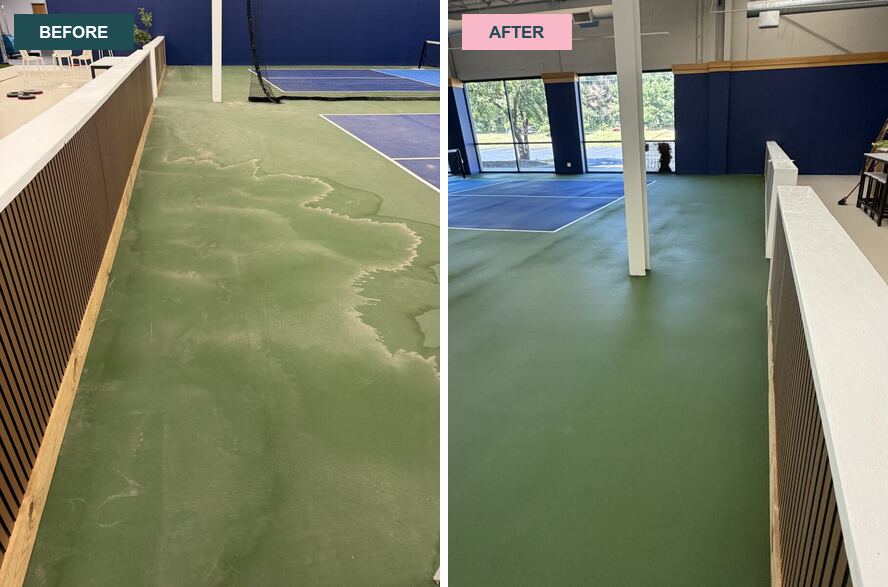
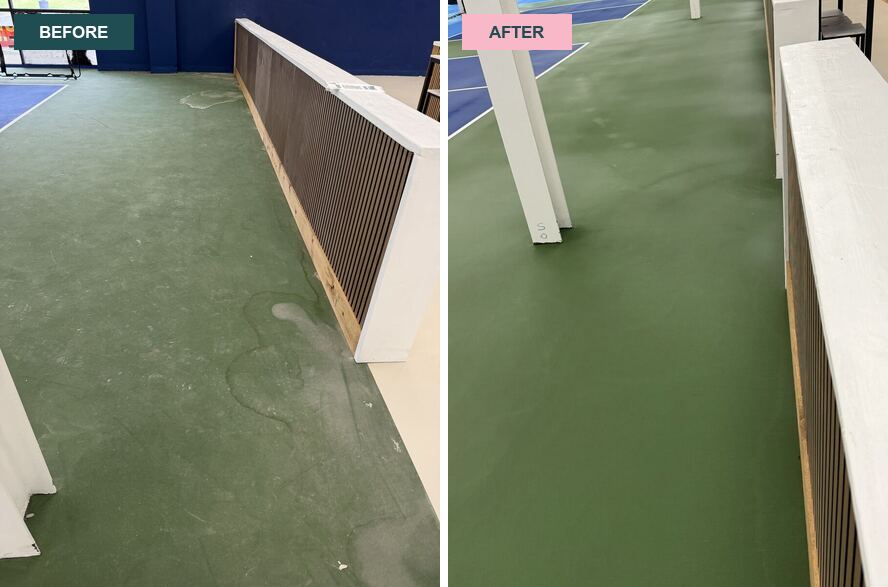
On the club in the photo above, the residue showed up as white, wavy tide lines on the green surround along the bench wall. They looked like dried puddle edges, because that is roughly what they were. Elsewhere it showed up as a flat haze that made the court look older than it is, and as footprints that stayed visible long after people walked across.
Players often notice it before staff do, because residue changes how a shoe grips the surface, and it doesn't change it evenly across the court.
Where it comes from
Residue usually traces back to one of these:
- The wrong product. Floor finishes, "shine" cleaners and gym-floor products are made to leave something behind. On an acrylic court, that something is a film.
- Too much product and no rinse. A mop puts cleaner down, and the water evaporates. The product stays. Every mopping adds another thin layer.
- Dirty mop water. By the third court, the bucket is mostly dirt, and the mop spreads it evenly into the film.
- Guessing the dilution. "A little extra to be safe" is how most rings start.
None of this is careless. It's what happens when the crew that cleans the locker rooms also cleans the courts with the same cart.
Why it's worth fixing
- Footing. Uneven grip is the thing members complain about, and it's the thing you don't want in a slip-and-fall conversation.
- It gets dirty faster. A film catches dust and shoe rubber, so the court looks dirty sooner after every clean.
- It makes good courts look worn. Haze reads as an old surface. Clubs start pricing a resurface when the court underneath is fine.
How we took it off at the Rockford club
This was the club's first visit with us, ahead of a 12-month monthly program. The film had to come off before the deep clean, or the deep clean would have just scrubbed on top of it.
- Photos first. Every court is photographed before any product touches it, so the starting condition is on record.
- Pre-treat the heavy areas. The rings along the bench wall and the high-traffic lanes got a neutral-pH treatment before the machine ran.
- Scrub and recover in the same pass. A commercial auto-scrubber with the right pad for the soil, in overlapping passes. The machine pulls the water back up as it goes. That step is what separates residue removal from mopping: the dissolved film leaves the building in the recovery tank instead of drying back onto the court.
- Then the full deep clean, followed by after photos of every court.
We never use a black pad or an alkaline degreaser to "cut through" residue faster. Both take the acrylic finish with them. If you want the details on pads, here's why the pad color matters.
How to keep it from coming back
- Dust mop, don't wet mop, for daily care. Dry dust and grit are what you're fighting between cleans.
- Keep floor finish and "shine" products off the courts. Put it in writing for your janitorial vendor.
- For spills, use a neutral-pH cleaner at the label dilution, and pick the water up. Don't let it dry in place.
- Get ready for winter. Road salt and slush come in on shoes from October on. Walk-off mats at the entrance and more frequent dust mopping keep it off the courts.
- Put machine cleaning on a schedule. Monthly works for most clubs. The busiest need it more often. Here's how to pick a cadence.
Think your courts have a film on them?
We'll clean one court overnight for free, with no commitment. Walk in the next morning, compare it to the court next to it, and decide.